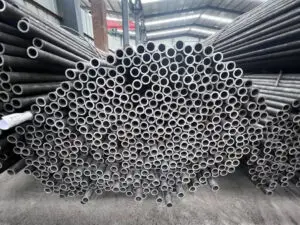
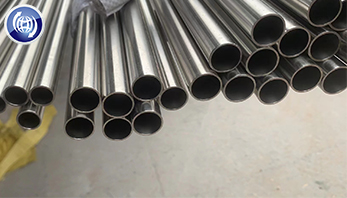
Seamless stainless steel pipes, as the name suggests, refer to stainless steel pipes manufactured using a seamless process. Compared to welded pipes, seamless steel pipes have significant advantages in strength and corrosion resistance. Their main materials include austenitic stainless steel (such as 304, 316, etc.), ferritic stainless steel, martensitic stainless steel, and duplex stainless steel, each exhibiting unique physical, chemical, and mechanical properties due to its different chemical composition.
Second, the Production Process of Seamless Stainless Steel Pipes.
The production process of seamless stainless steel pipes mainly includes several steps, such as hot rolling, piercing, cold rolling and cold drawing, heat treatment, and surface treatment. Hot rolling piercing is the first step in producing seamless steel pipes. By heating the steel billet at high temperature, the billet is pierced into a hollow tube using the force of the rolls and mandrel on a piercing mill. Subsequently, the pipe diameter is further reduced, and dimensional accuracy and surface quality are improved through cold rolling and cold drawing processes. Heat treatment is used to eliminate internal stress, improve microstructure, and performance. Finally, surface treatment processes such as pickling and polishing are used to obtain a smooth and beautiful finished seamless steel pipe.
Third, Application Areas of Stainless Steel Seamless Pipes.
The application areas of stainless steel seamless pipes are extremely wide, covering almost all occasions requiring high strength, corrosion resistance, and good sealing performance.
(1) In the aerospace field, its high strength and lightweight characteristics make it an important material for manufacturing structural components of aircraft, rockets, and other flying vehicles.
(2) In the petrochemical industry, stainless steel seamless pipes are used as pipelines to transport various corrosive media, ensuring production safety.
(3) In energy transportation, whether it is oil, natural gas, or nuclear energy, stainless steel seamless pipes are widely used due to their excellent corrosion resistance and sealing performance.
(4) In the food processing and medical device fields, the high requirements for hygiene standards and material safety also make stainless steel seamless pipes an indispensable choice.
Fourth, Quality Control of Stainless Steel Seamless Pipes.
Quality control is a key link in the production process of stainless steel seamless pipes. From raw material inspection upon arrival to finished product testing upon departure, every step requires strict control. Regarding raw materials, it is essential to ensure that the chemical composition meets standards and is free of inclusions, cracks, and other defects. During production, process parameters such as heating temperature, rolling speed, and cooling methods must be strictly controlled to ensure stable product performance. Finished product testing includes multiple aspects such as dimensional accuracy, mechanical properties, and corrosion resistance to ensure that the product meets design requirements. Furthermore, enterprises need to establish a comprehensive quality management system, obtain international certifications such as ISO, and continuously improve product quality and management levels.
Fifth, Future Development Trends of Stainless Steel Seamless Pipes.
With technological advancements and industrial development, the application fields of stainless steel seamless pipes will continue to expand, and market demand will continue to grow. In the future, the stainless steel seamless pipe industry will develop in the following directions:
(1) Towards high performance: improving product strength, corrosion resistance, and high-temperature resistance through optimizing material composition and process parameters;
(2) Towards environmental protection and energy conservation: adopting green production processes to reduce energy consumption and emissions;
(3) Towards intelligentization: utilizing advanced technologies such as the Internet of Things and big data to achieve automation, intelligence, and remote monitoring of the production process;
(4) Towards customization: providing personalized products and services based on customer needs.
https://www.tjxysteel.com/news/The-wide-application-of-seamless-stainless-steel-pipes-2093.html